
Most people look for startup ideas in the wrong order.
They start with tools. Or trends. Or a vague desire to “build with AI.”
That usually leads to a decent demo, a weak business, and months lost on something nobody truly wants.
A better approach is simpler. Start with what pulls your attention, match it to a real market, copy what already works, and only then look for the improvement that matters.
If you have more curiosity than capital, this is one of the strongest ways to decide what to build next.
Table of Contents
- What this framework is really for
- Before the idea: pick the right body of water
- The 3-board method for finding what to build
- Why mature markets are often better than sexy markets
- The proven, better, new framework
- A concrete example: curation as the wedge
- Do it by hand before you automate it
- How AI should fit into the process
- What to avoid when you are starting with little money
- How to know if you have “lightning in a bottle”
- Trust is often the hidden unlock
- Why copying is not as dumb as founders pretend
- Small first, then scale
- The “book of life” idea and why it matters for founders
- Alignment matters more than image
- A practical checklist for the next two weeks
- Common misconceptions
- What this means for AI startup ideas in 2026
- Final takeaway
- FAQ
What this framework is really for
This approach is useful for people in an unusually common position right now:
You do not have much money
You do have access to powerful AI tools
You want to build something real, not just experiment forever
You are unsure which idea deserves your next six months
The goal is not to invent from a blank page.
The goal is to reduce waste.
Instead of chasing originality too early, you use existing demand as a guide. Then you look for a new angle that is specific enough to test fast and cheap.
Before the idea: pick the right body of water
A strong startup is not only about having the best product concept.
It is also about entering the right environment at the right time.
One useful way to think about this is to separate the body of water from the boat.
If you choose the right market wave, your execution does not need to be perfect to create momentum. If you choose the wrong one, even a strong product can struggle.
Right now, AI is clearly one of those major bodies of water. That does not mean every AI startup wins. It means the underlying shift is large enough that many new behaviors, products, and business models become possible at once.
That matters because distribution, build cost, automation, and user expectations are all moving at the same time.
Still, “AI” is not an idea.
It is a context.
You still need a sharper way to decide what to make.
The 3-board method for finding what to build
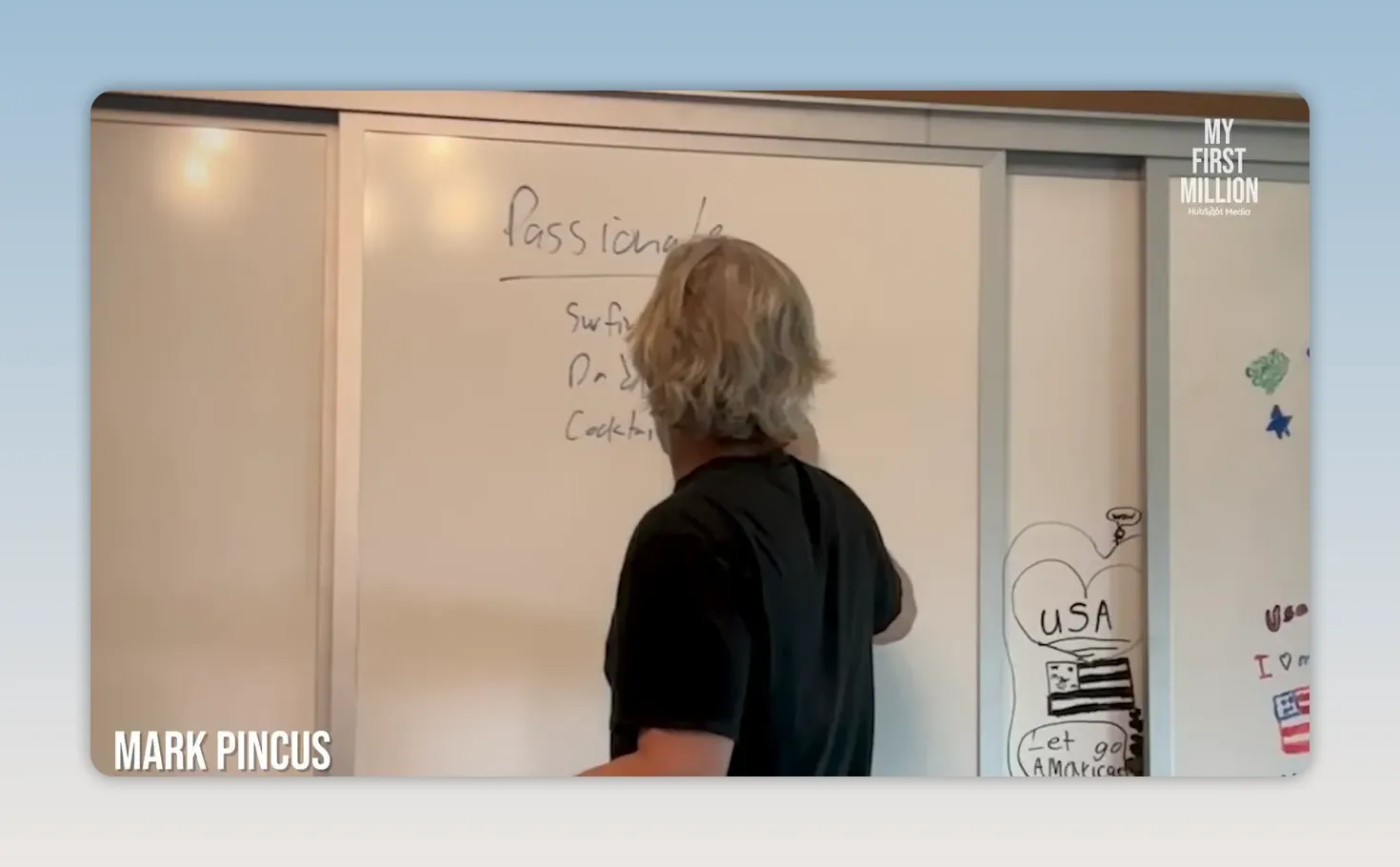
A practical way to generate ideas is to work across three lists, or three boards.
This is not complicated. That is the point.
Board 1: What are you genuinely into?
Start with interests, not business logic.
Write down things you actually care about, even if they sound unserious.
Examples:
Surfing
Parenting
Travel
Home design
Dating
Food
Connecting people
Video games
Music
Do not filter for prestige.
Do not ask whether venture capital would approve.
You are looking for areas where your taste, patience, and curiosity are naturally stronger than average.
Board 2: What are real businesses?
Now make a second list of markets that already produce real money.
This is critical.
You are not searching for abstract opportunities. You are searching for existing commercial behavior.
Examples:
Online dating
Jobs and recruiting
Travel booking
Video games
Local discovery
Lead generation
Marketplaces
Consumer subscriptions
Luxury services
The market can be mature. It can even be unfashionable.
In fact, mature markets are often better than trendy ones because demand is already proven.
Board 3: Mash the two together
Now connect the first two boards.
You are looking for intersections between things you care about and behaviors that already make money.
Examples:
Parenting + jobs
Food + local discovery
Home design + lead generation
Travel + concierge services
Dating + human curation
Gaming + social interaction
At this stage, you do not need one perfect answer.
You want several promising combinations that make you want to keep going.
Why mature markets are often better than sexy markets
Many founders think they need a brand-new category.
Usually they do not.
One of the better contrarian ideas is to look for a market that:
Already has a lot of revenue
Feels boring or saturated
Has obvious user behavior
Is not currently fashionable among investors
Why?
Because if money is already flowing, you do not need to prove the market exists. You only need to prove that your version is more compelling for a specific slice of users.
This is especially useful when you are starting small.
You do not have the budget to educate a market from scratch. You want to enter where demand is already alive.
Search, gaming, dating, local reviews, and travel all fit this pattern at different times.
The market may look “done.” That is often exactly why it is interesting.
The proven, better, new framework
Once you have a candidate idea, use a stricter filter.
Ask three questions:
What is already proven?
What is actually better?
What is merely new?
1. Proven
Start by identifying the existing product that already works.
Not approximately. Precisely.
If you are building a better local guide, start with the current local guide leader. If you are building a better dating product, start with the current mechanics users already understand.
Do not begin by changing everything.
Assume the incumbent spent years discovering what users expect.
2. Better
This is the hardest part.
“Better” does not mean “I prefer it.”
It means a clear majority of target users would strongly prefer it in a specific situation.
Not slightly. Clearly.
That bar is high.
Most founders think they have “better” when they actually have “different.”
Examples of possible better:
More trust
Less spam
Human curation instead of generic ranking
Higher-quality supply
Faster resolution in stressful moments
A far better mobile workflow
3. New
New is the easiest thing to add and the least valuable by itself.
AI features are often just new.
Agents are often just new.
Fancy generation layers are often just new.
New can help. New can attract attention. But new does not rescue a weak product experience.
If your idea is mostly “the old thing, but with AI,” that is not enough.
The right sequence is:
Copy what is proven
Find one improvement users obviously want
Use new technology only where it strengthens that improvement
Turn any video into content. |
|
Check out this really cool thing |
| Click me |
A concrete example: curation as the wedge
One strong pattern that shows up across categories is human curation.
Take a category like local recommendations.
A broad platform can contain everything, but that often makes trust weaker. If a narrow expert or tastemaker reliably helps people find the best ramen in New York or the best coffee in Florence, that curation can be more valuable than a giant generic platform.
That does not mean you immediately build a massive app.
It means you ask:
Can trusted curation beat algorithmic clutter for one category in one city for one type of person?
That is small enough to test.
And if it works manually, then AI may help scale the workflow later.

Do it by hand before you automate it
This is where many AI founders go wrong.
They automate before they validate.
If your core value is curation, screening, concierge support, or judgment, first prove people want the outcome.
Do it manually.
Examples:
Hand-pick the best listings yourself
Personally match customers to options
Manually build a short list for one neighborhood or niche
Offer a text-based concierge before building a full app
If users do not clearly prefer the human-first version, software will not save you.
If they do prefer it, then you can ask where AI reduces cost, increases speed, or extends reach.
This order matters.
The breakthrough is the experience. The automation comes later.
How AI should fit into the process
AI is powerful here, but not in the way most people think.
Its best early role is not “invent a billion-dollar company for me.”
Its best role is to compress execution cycles.
You can use AI to:
Prototype landing pages
Build rough internal tools
Create research summaries
Draft onboarding flows
Simulate support workflows
Generate copy and test positioning
Build simple agents that act like early employees
The advice here is almost extreme in its simplicity:
Force yourself to do as much as possible with AI first.
Not because AI guarantees quality, but because it exposes what still requires human judgment.
That boundary is useful.
It shows you where the product’s real value lives.

What to avoid when you are starting with little money
If capital is tight, the wrong decisions become expensive fast.
Three common mistakes stand out.
1. Founding the full company too early
You do not need the full structure on day one.
You need signal.
A lot of founders create the identity of a company before they have earned the right to one.
2. Hiring expensive engineers before finding the wedge
If you do not know what must be built, hiring full-time talent can lock you into the wrong path.
Use AI, cheap experiments, contractors, and manual processes first.
3. Falling in love with the big version
The big version is emotionally seductive.
You imagine the category leader, not the first use case.
That usually leads to vague products and bad prioritization.
You need one small use case that works intensely well before anything else.
How to know if you have “lightning in a bottle”
Sometimes an idea is just decent.
Sometimes it has unusual force.
There are two kinds of signals worth watching.
Behavioral signals
People come back a lot.
They tell others without being pushed.
They bend their habits around the product.
In strong consumer products, extreme engagement can be the clearest evidence that something special is happening.
Anecdotal signals
You hear the product unexpectedly in the wild.
You see people using the language of the product on their own.
You notice genuine pull instead of polite interest.
The important point is that these moments usually feel obvious in retrospect.
If you constantly need outside reassurance that your product might be special, it probably is not yet.
Trust is often the hidden unlock
One repeated lesson across social and consumer products is that trust changes everything.
Not trust as branding language.
Trust as a product property.
Users share more, return more, invite others more, and behave more honestly when they believe the environment is safe, legible, and coherent.
That can come from:
Real identity
Strong curation
Higher-quality participation
Better moderation
A narrower use case
Clearer social norms
If you are looking for a wedge in a crowded category, trust is one of the best places to search.
Why copying is not as dumb as founders pretend
Founders often resist copying because it feels unoriginal.
That is usually ego talking.
Markets routinely reward improved versions of existing ideas.
Copying the proven parts of a product is not the same as building a lazy clone.
It is often the fastest way to focus your energy on the one thing that matters.
If you copy everything exactly, you probably lose.
If you copy the right baseline and improve the right dimension, you may create something distinct enough to matter.
That is not moral weakness. It is market reality.
Small first, then scale
Another trap is optimizing for scale before product quality.
If your first version works for everyone a little, it may work for no one enough.
The better move is to go painfully narrow.
Examples:
Only coffee shops in one city
Only premium airport ride service in one metro area
Only travel rescue for flight disruptions
Only curated dating intros for one audience
Only job matching for parents returning to work
If that first slice feels obviously better, then expansion becomes much easier to reason about.
The “book of life” idea and why it matters for founders
Startup advice often focuses on markets and products while ignoring self-honesty.
That is a mistake.
One valuable practice is to keep a recurring written record of what you say you want, year after year.
The point is not productivity theater.
The point is truth.
If you keep saying you want to build something, learn something, or pursue something, and you never move toward it, that is useful information.
Maybe the goal matters. Maybe it does not.
Either way, writing creates a conversation across time with yourself.
This matters for founders because a lot of wasted years come from attachment to imagined potential instead of actual commitment.
Sometimes the right move is not to push harder.
Sometimes it is to admit that the goal does not really belong to you.
Alignment matters more than image
There is a quieter point underneath all this.
Choosing what to build is not only a business question. It is a life question.
The strongest projects usually sit at the intersection of:
Something you can stay interested in
A market that is real
An improvement users clearly want
A distribution path you can actually reach
This is part strategy and part alignment.
If you build only for status, you will probably choose the wrong market or the wrong timeline. If you build only for personal fascination, you may ignore whether anyone pays.
The overlap is the game.
A practical checklist for the next two weeks
If you want to apply this framework immediately, do this:
Day 1 to 2: Create your three boards
Write 20 things you genuinely care about
Write 20 real internet or software businesses
Create 20 mashups from the two lists
Day 3 to 4: Pick 3 ideas worth pressure-testing
Which ones excite you enough to keep exploring?
Which ones clearly sit in real markets?
Which ones suggest an obvious user problem?
Day 5 to 7: Identify the proven product
What existing product already wins here?
What does it do that users already understand?
What exactly would you copy first?
Day 8 to 10: Define one “better” dimension
More trust?
More curation?
Better response in high-stress moments?
Better supply quality?
Lower friction?
Day 11 to 14: Test it manually
Deliver the service by hand
Use AI only where it speeds workflow
Talk to users
Measure whether they clearly prefer it
If the answer is no, kill it fast.
If the answer is yes, build the smallest software layer possible.
Common misconceptions
You need a totally original idea
No. You need a meaningful advantage.
AI itself is the business
Usually not. AI is more often the enabler than the end product.
If the market is mature, it is too late
Mature often means demand is proven.
You should scale as soon as something works a little
No. First get a small use case working very well.
Better means more features
Often the opposite. Better is usually clearer, narrower, safer, faster, or more trusted.
What this means for AI startup ideas in 2026
The big opportunity is not just making software cheaper to build.
It is redesigning product experiences around near-free intelligence.
That opens several promising directions:
Digital concierge products
Curated marketplaces with AI-assisted operations
Generative consumer tools that make people feel creative, not just entertained
Services that start free or cheap with AI and escalate to humans in moments that matter
Consumer products where trust and judgment are the real moat
But the old rule still applies.
Technology alone is not the insight.
The insight is where behavior changes and why users care.
Final takeaway
If you are starting with little money, do not begin by asking what AI can do.
Begin by asking:
What do I care about enough to stay with?
Where is money already being spent?
What product already proves demand?
What one thing could be clearly better?
Can I test that by hand before I build too much?
That is a much calmer and more reliable way to find the right startup idea.
Not perfect.
But real.
FAQ
How do I find a startup idea if I have no money?
Start with interests, connect them to real markets, copy a proven product model, and test one clear improvement manually before spending heavily. AI can reduce build cost, but the main goal is to validate demand before you hire or scale.
What is the best AI startup framework for beginners?
A strong beginner framework is: list your passions, list real businesses, combine them into idea mashups, identify the proven incumbent, define what is truly better, and use AI to prototype only after the core value proposition is clear.
Should I build something original or copy what already works?
Start by copying what is already proven, then improve one dimension that users obviously care about. Pure originality is overrated if it ignores existing user behavior and demand.
What does proven, better, new mean?
Proven is the existing product pattern users already accept. Better is the part users clearly prefer in your version. New is whatever is different but not yet demonstrated to matter. The mistake is confusing new with better.
When should I use AI in the startup-building process?
Use AI early for research, copy, prototypes, workflows, and lightweight automation. Do not rely on AI to compensate for a weak product idea. First prove the experience users want, then automate what can be scaled.
Are mature markets still good for startups?
Yes. Mature markets can be excellent because spending behavior is already established. If you can bring more trust, better curation, or a better user experience to a specific slice of that market, you may have a strong entry point.


